Image: Princeton University Press
A manifesto for “networked science”: the argument that internet-era tools can dramatically accelerate discovery — but only if science becomes genuinely open.
Type: book
By: Michael Nielsen
When: October 2011 (Princeton University Press; Princeton Science Library reissue 2020)
Where it sits in their arc: the landmark
Where to get it / join: Reinventing Discovery | Princeton University Press
What it is
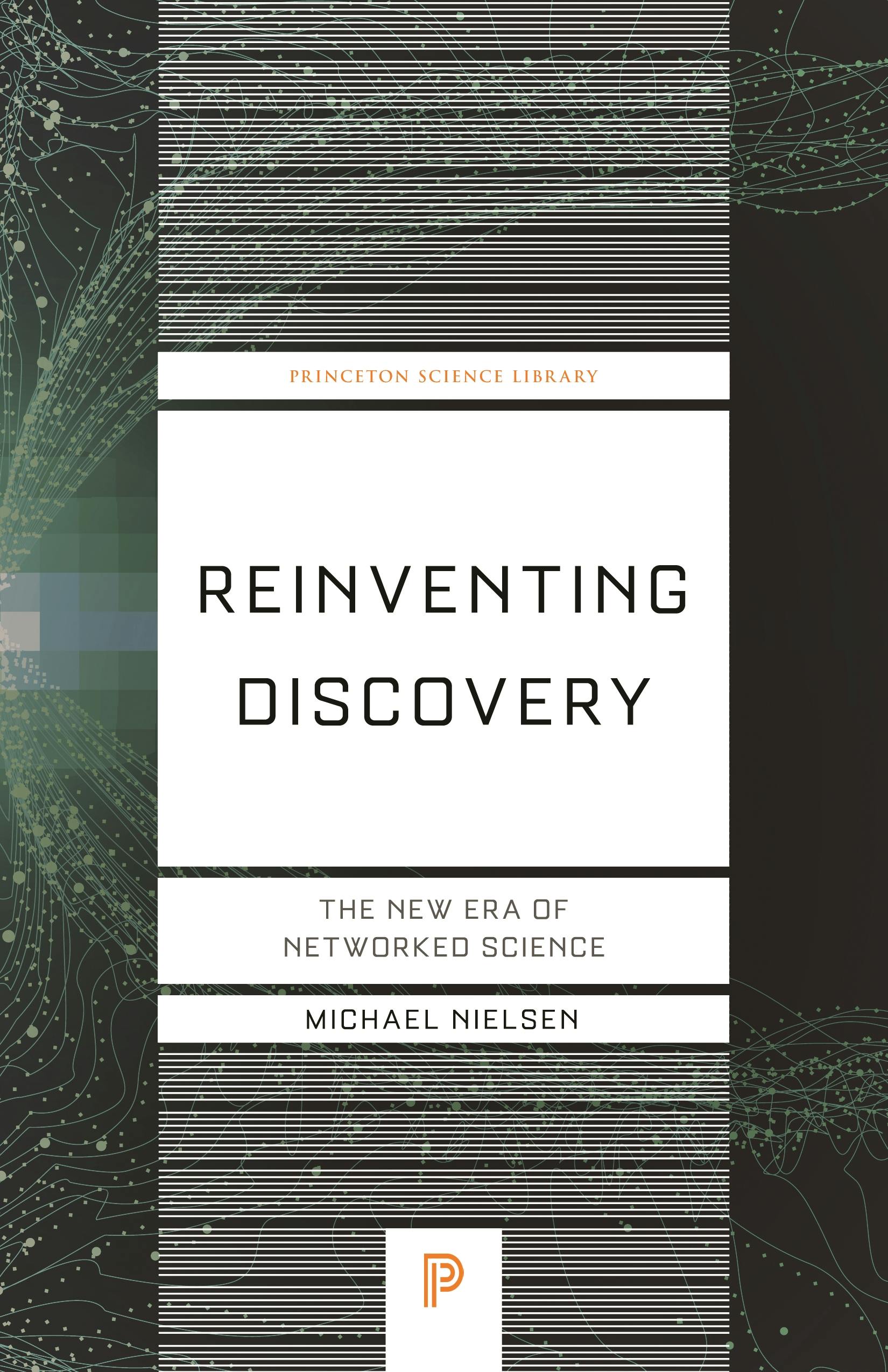
Reinventing Discovery: The New Era of Networked Science argues that we are living through the most dramatic change in how science is done in over 300 years, driven by new online “cognitive tools” that let researchers pool intelligence at a scale never before possible. Nielsen builds the case from concrete episodes — the Polymath Project’s collaborative mathematics, the Galaxy Zoo citizen-science effort, open genomics — and turns them into a general theory of how networked collaboration amplifies collective intelligence. It is equal parts reportage and manifesto: networked science, he insists, can only realise its potential if it is open science. The book was named a Boston Globe Best Science Book of 2011.
Core ideas
- Amplifying collective intelligence — The right online tools let groups attack problems no individual, and no traditional team, could solve.
- Designed serendipity — Structuring collaboration so the right expertise and the right problem find each other.
- Open science as a precondition — Without open sharing of data, methods, and partial results, the network effects never compound.
- The incentive problem — Why the reward system of academic science resists openness, and what would have to change.
How it connects to the Guild’s practice
The Guild is itself a networked-intelligence experiment — a commons where members share notes, methods, and half-formed ideas in public. Reinventing Discovery is the most rigorous account of why that works and what makes it fail. It widens the tools-for-thought lens from the individual knowledge worker to the collaborating group (see The Disciplines — Many Lenses, One Room), and it is the natural bridge between Nielsen’s open-science roots and his later mnemonic-medium work.
Related works
- How can we develop transformative tools for thought — moves the same ambition from collective discovery to individual cognition.
- Neural Networks and Deep Learning — Nielsen’s open, free-to-read book is open science put into practice.
- Quantum Country — the experiment that grew out of the questions this book opened.
Notes from the room
Space for members to add takeaways and how they used it.