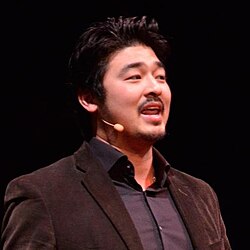
Photo: Wikipedia / Wikimedia Commons
The gamification pioneer who mapped human motivation into eight core drives — the Octalysis Framework — and made “gamification beyond points, badges, and leaderboards” his life’s work.
Field / lens: Gamification, behavioral design (see The Disciplines — Many Lenses, One Room)
Based in: Taiwan (born Taipei; Taiwanese-American, raised across Taiwan, South Africa, and the United States; long worked from California)
Timezone: Taiwan — CST (UTC+8); note he speaks and consults globally and works nomadically across time zones
Why they matter to the Guild
Chou gave the field a structured, human-focused way to think about motivation rather than reward-bribing. Where much of “gamification” stopped at points and leaderboards, Octalysis asks what actually drives a person to act and sorts those drives into eight forces — a lens any knowledge worker can use to design habits, learning, and tools that people genuinely want to return to. For a community built on play, mastery, and sustained practice, his work is foundational vocabulary.
The arc of their work
- Before — Began studying gamification systematically around 2003, well before the term went mainstream; built and grew the framework through years of design, consulting, and speaking.
- The landmark — Actionable Gamification: Beyond Points, Badges, and Leaderboards (2015), which codified the Octalysis Framework and its 8 Core Drives. The book sold 100,000+ copies and is cited across thousands of academic works.
- After — Co-founded the consultancy The Octalysis Group and launched Octalysis Prime, a gamified learning and mentorship community. Most recently co-authored 10,000 Hours of Play (2025) with Mark Diaz, turning gamification inward — designing your own life like a great game.
Key ideas and terms
- Octalysis Framework — A model that organizes human motivation into 8 Core Drives, arranged on an octagon. See the canonical note Octalysis Framework; glossary entry Glossary — Shared Language.
- 8 Core Drives — e.g. Epic Meaning & Calling, Development & Accomplishment, Empowerment of Creativity & Feedback, Ownership & Possession, Social Influence & Relatedness, Scarcity & Impatience, Unpredictability & Curiosity, Loss & Avoidance.
- White Hat vs. Black Hat gamification — Drives that make people feel powerful and fulfilled vs. drives that compel through urgency, scarcity, and fear; lasting design favors White Hat.
- Intrinsic vs. extrinsic motivation — The book’s core argument: durable engagement comes from meaning and mastery, not from bolting rewards onto a dull task.
Their works
Books
- Actionable Gamification
- 10,000 Hours of Play
Communities - Octalysis Prime
Consultancy - The Octalysis Group
Find them
- Site: https://yukaichou.com/
- Newsletter: via yukaichou.com (free Octalysis roadmap at Free Gamification Course & Octalysis Roadmap by Yu-kai Chou)
- YouTube: Octalysis Prime — https://www.youtube.com/c/OctalysisPrimeExposed
- Podcast: —
- X / Twitter: Yu-kai Chou (@yukaichou) / X
- LinkedIn: Yu-kai Chou - The Octalysis Group | LinkedIn
- Other: Octalysis Prime — https://island.octalysisprime.com/
Related leaders
- Mark Diaz — Co-author of 10,000 Hours of Play and a 10K HP / Digital Fitness collaborator; the bridge between Chou’s gamification and the play-and-mastery wing of the Guild.
- Martijn Aslander — Shares the play-as-serious-practice thesis (Aslander’s Digital Fitness and “10,000 hours of play” framing overlap conceptually); both treat sustained playful engagement as a route to capability.
Sources
- Yu-kai Chou official site — https://yukaichou.com/ ; Octalysis Framework explainer — The Octalysis Framework: 8 Core Drives of Gamification | Yu-kai Chou
- Actionable Gamification book page — Actionable Gamification Book by Yu-kai Chou (Octalysis)
- Octalysis Prime — https://island.octalysisprime.com/ ; https://join.octalysisprime.com/op-fr/
- 10,000 Hours of Play book page — 10,000 Hours of Play — Yu-kai Chou's New Book (Order Today) ; launch post — 10,000 Hours of Play: Why Play Beats Practice (New Book) | Yu-kai Chou
- Wikipedia — Yu-kai Chou - Wikipedia